A time capsule of life: Leigh Bowery at Tate Modern
I made it to Leigh Bowery at Tate Modern and was absolutely blown away.
I made it to Leigh Bowery at Tate Modern and was absolutely blown away.
First of all, I haven’t seen people deliberately dress up for a show in a long time. Second, it made me feel nostalgic for the free, underground London I never actually got to see. This wasn't a retrospective. It’s a celebration of life. A time capsule. A litmus test of an era when drag, excess, and art weren’t a pose, but a way of being. A reminder: art lives in clubs, in friendship, in youth, in community. Find your people, don’t stay in isolation.
And yes, Leigh totally proves the theory that the most successful people drop out of college or uni.
Leigh Bowery (1961–1994) — a boy from the suburbs of Melbourne, from a place literally called Sunshine. He is bored.And that boredom becomes his driving force. Inspired by the punk scene, he drops out of fashion college and moves to London in the autumn of 1980 — right at the peak of the New Romantics. By December, he’s writing his New Year’s resolutions — like a manifesto for his future life:
- Get weight down to 12 stone
- Learn as much as possible
- Become established in the world of art, fashion or literature
- Wear make-up every day
He described himself as: fashion designer, club monster, human sculpture, nude model, vaudeville drunkard, anarchic auteur, pop surrealist, clown without a circus, piece of moving furniture, modern art on legs. His face — a canvas, his makeup — the paint. FASHIONING A WORLD in its purest form.
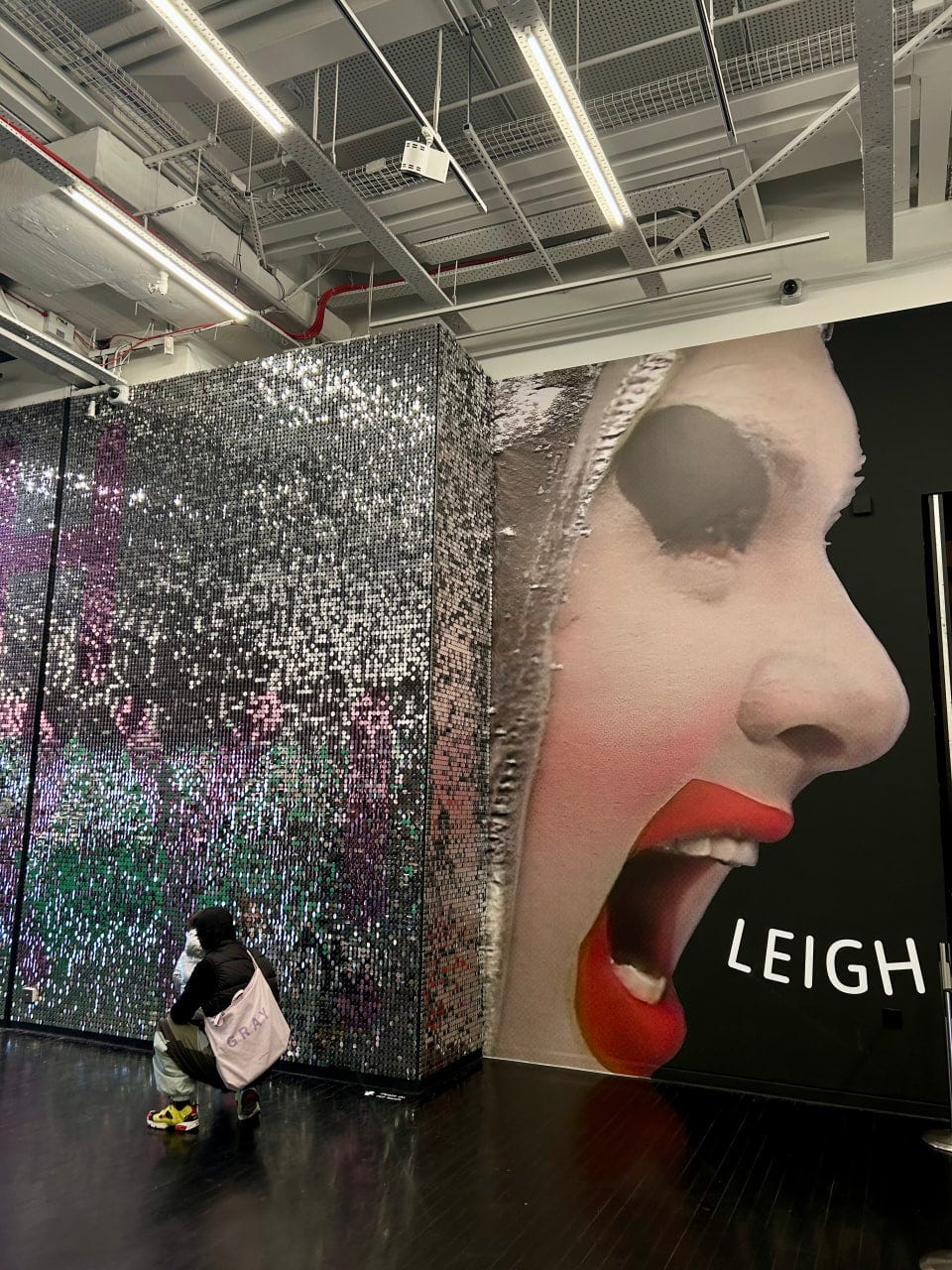
Leigh turned his short but blazing life into a never-ending performance. He was meant to burn fast and bright. He didn’t want to be part of the underground culture — he was the underground. A troublemaker — pardon my French. His face was a canvas, his clothes — a challenge, Taboo club — a place where there were no taboos. The phrase “the bitchiest club of the moment” was literally written on the museum wall — an official title Leigh would’ve totally approved of. “Would you let yourself in?” — asks the club bouncer and a mirrored wall installation.
The most fashionable place to see-and-be-seen is Taboo on Thursday. The policy is simple. Dress as though your life depends on it, or don’t bother. — TimeOut
He was Lucian Freud’s muse, a designer, model, artist, producer, drag star — and just a punk who wanted to be “that weird guy on the street you’d tell your mum about.”
Hardcore normcore and “I can't really tell the difference between a stage and the street” — for him, these weren’t metaphors. They were his everyday reality, built of glitch, glitter, paint and drugs.
Right from the entrance — sequins, colour, loud headlines. Everything was deliberately garish. The paintings hung crooked, the walls were covered in surreal wallpapers, disco music was playing. Youth forgives everything: honestly, I’d love for my party photos with friends to end up in the UK’s most important museum. Pure drag and camp. Photos, costumes, films, music videos, and even paintings.
In 1994, Leigh married his friend Nicola Rainbird — officially to avoid deportation (he’d been arrested for having sex in a public toilet), but really as another act in his life-performance. Their final artistic collaboration? A birth on stage: Rainbird, painted red, emerges upside down from Leigh’s costume, with a string of sausages for an umbilical cord. Their band Minty turned bodily fluids into art: apple juice became urine, pea soup became vomit. In the middle of the AIDS crisis, Leigh displayed what others tried to hide. He died at 33, on New Year’s Eve, of AIDS-related illness.
This wasn't just an exhibition — it’s a rave, a costume party, a burst of freedom, camp, thoughts about the body, disco and drama that you didn’t just want to look at — you wanted to live through it. Loudly. With fire. Until the fire alarm goes off. (Spoiler: It did. They actually evacuated us.)
And this feeling of freedom in the air?I still feel it in London.Or am I just imagining it? Tension between contradictions?