Ai Weiwei doesn't care if you're comfortable
Notes from a sold-out London evening
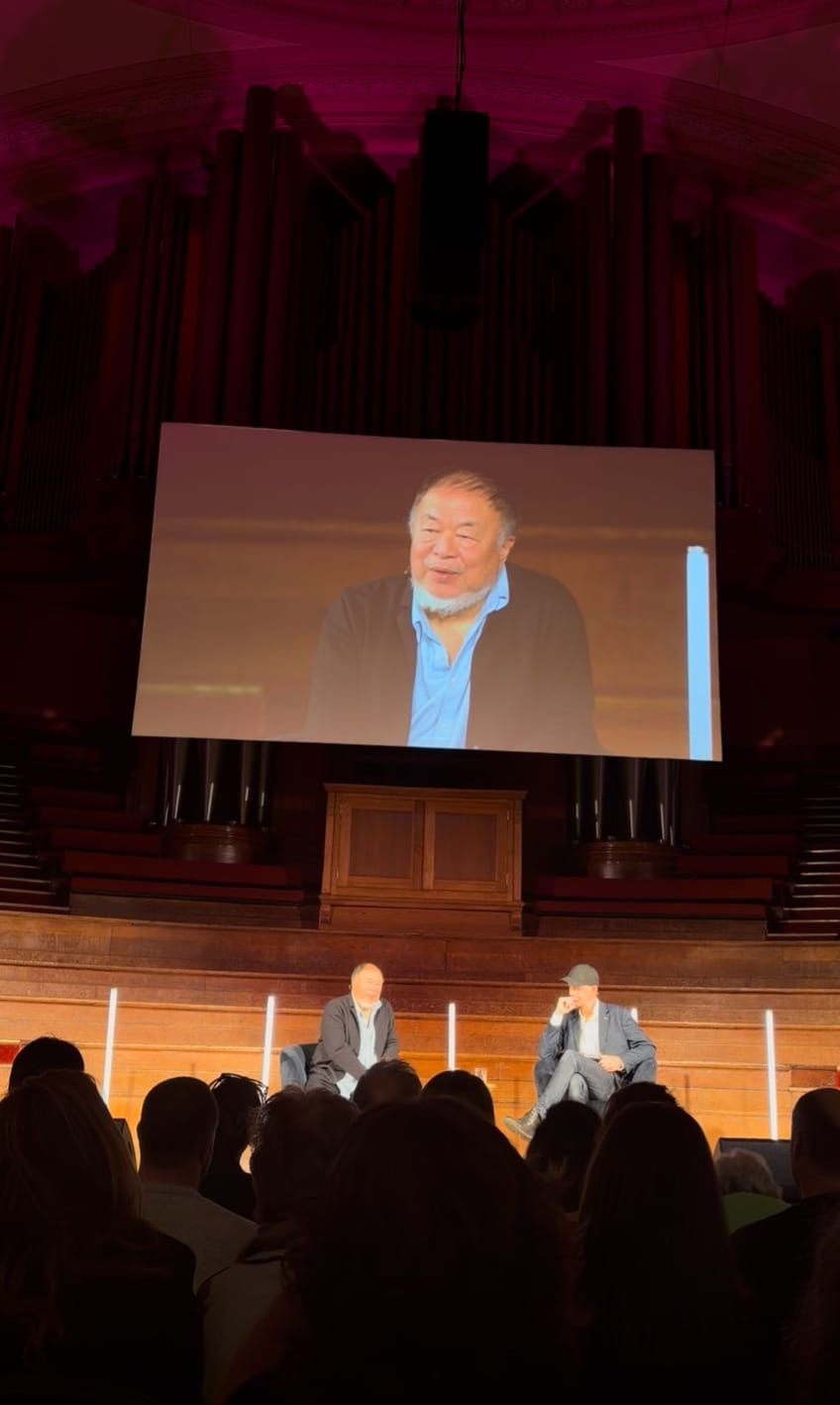
Last Saturday, I sat in Central Hall Westminster watching Ai Weiwei spar with BBC’s Stephen Sackur for 90 minutes. The room was sold out. The questions were pointed. The artist was, predictably, impossible to pin down.
Sackur tried. God, did he try. Armed with the journalist’s arsenal of leading questions and Western assumptions about freedom, he pushed Ai Weiwei on censorship, China versus the West, political art, and whether suffering under authoritarianism makes you morally superior.
Ai Weiwei pushed back on absolutely everything. Here are some highlights:
On self-censorship
When asked about surveillance becoming “internal” (when people edit themselves before anyone else needs to) Ai Weiwei didn’t hesitate:
His answer: “I think that surveillance only works when self-surveillance has been established.”
He went further, pointing out that in every society, education teaches us “how to be safe, how to secure.” We’re trained not to hurt ourselves. And then he said what everyone was thinking but no one wanted to hear: “Anybody should be aware self-censoring is very well established in the West.”
When Sackur suggested maybe the conversation was getting “too dark,” Ai Weiwei called it out: “That’s also a sense of censorship.”
Accurate.
On whether the West is actually that different
This is where it got uncomfortable for everyone in the room.
Sackur kept insisting there’s a “profound difference” between political repression in the United States and China. That in the West, you can be an artist in ways you simply cannot be in China.
Ai Weiwei’s response? “No, I can’t be an artist in China. I can’t sell my art.”
But when Sackur called him a contrarian, Ai Weiwei was just Ai Weiwei: “I’m not.”
He wasn’t being difficult. He was refusing the binary. Yes, there’s a Communist Party in China. Yes, there’s surveillance. But he kept pointing to what he called Western hypocrisy, the idea that censorship and control only happen “over there” while ignoring the more insidious forms here.
On whether he and Xi Jinping took different lessons from similar experiences of repression (both their fathers were persecuted during the Cultural Revolution), Ai Weiwei said something that stuck with me: “We are not in the same position. Our words dictate, you know, because you have to manage... We are not in the same position.”
Meaning: stop asking me to perform moral superiority over someone whose reality I don’t live.
On why he still has a chinese passport
Someone asked why he hasn’t renounced his Chinese citizenship after everything — the surveillance, the detention, the destroyed studio, the 81 days in prison.
His answer was both simple and stubborn: “I would own another passport from any nation before raising my hands to say I’m a lawyer. Even I was given a Chinese passport, so I think that easy condition to accept.” (The transcription quality makes this hard to parse, but the point was clear: he’s not interested in symbolic gestures of renunciation.)
When asked if there’s any nation he’d want a passport from, he said no. Then added: “I’m a pretty simple person, and I’m also a pretty stubborn person. That’s for sure.”
On his son
Ai Weiwei was detained in 2011. When he was released, his two-year-old son apparently said something to the effect of: they just made you bigger, you’ll be more famous.
Ai Weiwei’s take: “As a child he tells the truth.”
He also recounted that Chinese authorities told him: “If it’s not because of us, you will never become so famous.”
His response: “Yes, I’d take the loss from the enemy.”
Now his son is a teenager, and Sackur asked how he’s raising him. The answer: “I’m going to equip my son to the maker of as much problem as he can handle.”
Cheers to make trouble intentionally!
On social Media and information overload
In the early days of Twitter, Ai Weiwei posted endlessly. It was subversive, powerful, a tool for resistance.
When asked if he’s disappointed with what social media has become, he said: “I’m not disappointed. I really accept the new reality.” Then explained that when things become “so easy and so convenient, everybody can use it. They also become disingenuous.”
He compared our information landscape to walking into a supermarket: “There’s millions of products here. With that in the air, you don’t want to choose. So today we are facing much worse situation. It’s so floating. We have no clear experience to make a judgment. This is devastating.”
On technology, AI, and the future (spoiler: he’s not optimistic)
Someone asked if AI is having a positive or negative impact on contemporary art and culture.
Ai Weiwei basically said the question doesn’t matter: “It doesn’t matter because I don’t even know what the positive impact is on the system.”
Later, when discussing whether technology could eventually eliminate our basic human desire to challenge and question, he warned: “I think the society will become so-called absolute correct and there is a danger of Nazis once you have your absolute right.”
His point: if we stop insisting on being different, on hearing different voices, we’re finished. Technology will make that decision for us. “You know, they already increased maybe 80% of our jobs. Then they said the only thing you can do is growing some vegetables.” (I personally wouldn’t mind).
On artists and responsibility
When asked what responsibility artists have when they say controversial things — whether they have a duty to “correct” themselves or society — Ai Weiwei cut through it:
“The answer to this is that artists is not a bad position it’s a bad job.”
The transcription makes this garbled, but his meaning was clear: stop treating “artist” like it’s a professional credential or moral authority. Art isn’t a position you hold. It’s not about providing acceptable answers or making people comfortable.
On fear, silence, and integrity
The question everyone wanted answered: Have you ever been too frightened to show or publish something you created?
The answer is no.
But when asked if the risks are worth it when the outcome might not change anything, he said: “I don’t feel regret leaving this world. I would say I did something I need to do. Yeah, that’s me. I don’t expect I can change anything. Then added: “That’s what I said, well, this is integrity. Integrity being a so-called artist.”
On what he misses about china
This moment was unexpectedly human.
“Two things. One is that I’m teaching in my own language. I speak a strange English... I feel ashamed for days after I’ve learned that.”
And: “Also something I really miss is Chinese cooking.”
Sackur asked what he thinks of Chinese food in the UK. Ai Weiwei’s response: “There are some good ones.”
Diplomatic.
Throughout the evening, Sackur kept trying to frame everything as good guys versus bad guys, freedom versus oppression, the West versus China. Ai Weiwei kept refusing to accept those terms.
Near the end, someone asked where we find self-confidence to fight censorship in today’s world. Ai Weiwei: “Anti-censorship is not just coming from confidence. Human beings have rights to say differently, a voice, you know, a law. Those are very essential rights.”
Then he turned it back on the audience, asking why we teach our kids to self-censor: “Give our kids the message... Most of us, we do tell our kids perhaps to be cautious, you know, to play safe, to understand that the world’s a difficult place.”
But he’s doing the opposite: “I’m going to equip my son to the maker of as much problem as he can handle.”
So…
Are you making trouble? :)
P.S. The transcription of this event was terrible, so if I’ve misrepresented anything, blame the technology. Which feels appropriately on-theme for an Ai Weiwei discussion.