How And Just Like That almost buried the legacy of Sex and the City
Bidding farewell to the worst sequel in television history
Below is my English translation of a column I originally wrote for SETTERS Media about how And Just Like That nearly buried the legacy of Sex and the City. The original text (in Russian) can be found here.
Last week HBO announced that after three seasons it is shutting down And Just Like That — the most absurd continuation of the cult classic Sex and the City. As a lifelong fan of the original, I tried to understand what went wrong, and whether the show could have been saved even a little.
Let’s start with the obvious: Sex and the City once shaped the very language of female friendship and sexuality. It was a form of emotional therapy — we watched it with girlfriends over wine, during breakups, on our periods, and in many other moments when it worked better than antidepressants. Even the two glossy and ridiculous movies that followed the series managed to console us: they made us laugh, cry, and feel less alone in our own catastrophes. So when in 2021 a sequel was announced, we all rushed to watch. But let’s be honest: And Just Like That became a textbook example of how to kill faith in pop culture.
If the first season could still be watched out of curiosity — like looking at a friend after plastic surgery, familiar yet disturbingly different — the second wave brought the realization that this was no comforting chicken soup, but instant broth from a cube. Instead of emotional support, we got second-hand embarrassment. Glimmers of the old charm appeared in dinner parties and soirées, but instead of wit we got awkward silences, sterile jokes, and the sense that every line had been vetted by a human rights lawyer. They should have just offended everyone equally — at least then we might have laughed, as we did with the unapologetically un-PC original.
Three main problems
The list is long, but the core issues are three.
Forced inclusivity
The creators seemed to tick off an Excel spreadsheet: gender, skin color, religion. Every box checked except disability (unless you count Steve’s sudden hearing loss, treated as a gag, and Carrie’s briefly deaf colleague in season one) and political diversity. Instead of new, compelling characters, we got a parade of caricatures. My “favorite” inclusion? Brady’s pregnant teenage girlfriend, who seemed to exist solely as a punchline at the expense of the non-elite, non-Manhattan class.
The disappearance of sex
The very thing that made the original groundbreaking — candid conversations about sex — is entirely absent. And Just Like That never showed the world what sex looks like for women over 50. Everything is sanitized, bland, safe. Where’s the detail? The bodies? The chaos, the awkwardness, the absurdity? Why no mention of vaginal atrophy, menopause, or the idiotic pillow talk that made the original so raw? Instead, we get crisp sheets, polite kisses, and Charlotte acting like she stumbled into a PTA meeting instead of a bedroom. A show that once made sex speakable ended up killing it with silence.
No character development
Despite all the “woke” storylines crammed into the scripts, by season three it was clear: the characters hadn’t evolved at all. They’d merely been given awkward costume changes. Carrie remained the same toxic friend, except now there’s a banana in her fridge instead of Marlboro Lights. Miranda — once the embodiment of cynical, sharp-edged femininity — has simply turned into Cynthia Nixon, perpetually chasing a “new sexuality.” Charlotte is stuck in her eternal “everything’s fine,” which translates into terminal boredom; not even Harry’s prostate cancer could draw a tear.
Meanwhile, Seema — written in as Samantha’s replacement (and the only one who truly benefited from Kim Cattrall’s refusal to return) — spends her fifties obsessing over her very first wedding dress, as if she just wandered out of a Disney retrospective.
Style, or the lack thereof
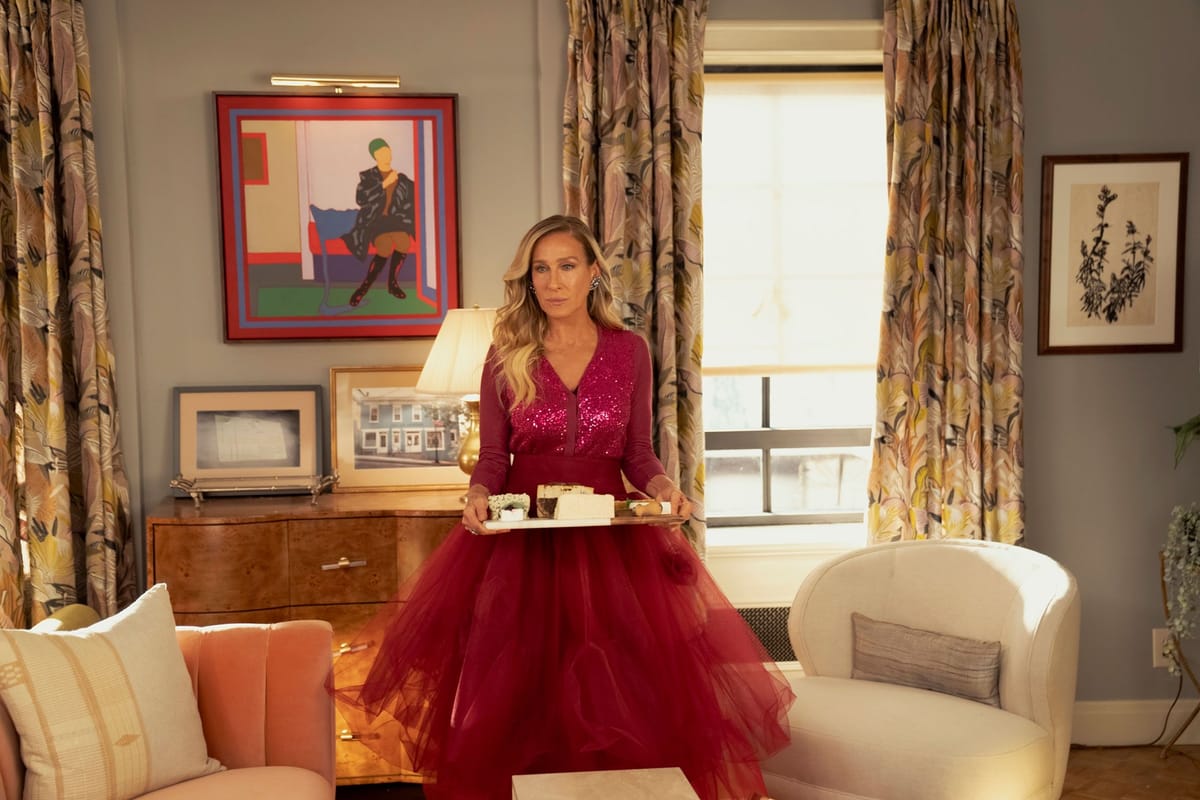
I didn’t want to talk about style, but here we are. How many times must we suffer through that tulle skirt? It’s no longer a symbol of freedom and whimsy, but a dusty museum relic dragged from episode to episode. Carrie could have buried it alongside Big, and the city would have breathed a sigh of relief. Instead, it haunts us like a ghost, a reminder that nothing evolves here — not even the wardrobe. Worst of all, Carrie Bradshaw would never have chatted through a fashion show. For her, the runway was church, shoes were religion. Yet here she is, gossiping in the front row like she’s at a business lunch.
What could have been done?
At the very least, give the show an honest ending. Push Carrie down the stairs in her beloved Manolos, let her break a hip, and gather the friends (men, of course, wouldn’t show up) for one final wake. A week later, Sotheby’s would auction off her wardrobe, and all of New York would scramble for the last pieces of the myth. That would have been the kind of self-irony the show so desperately lacked.
Another option: bring back Big. Not as a ghost in a white shirt, but as a conman who faked his death and now lives in the Caymans, hiding from an insider trading indictment. Spin it into a new series — Big in Paradise. After all, if Lisa’s father could be killed off twice by accident, why not resurrect the archetype of the emotionally unavailable rich white man? Give us at least a beautiful lie, since the truth was unbearably boring.
The end
In the final episode, Carrie finally realizes: she will live alone. But what was once a manifesto of freedom — a woman with champagne, striding into her own life against the Manhattan skyline — now looks like an old lady sitting on the stoop, endlessly talking to herself while the neighbors take detours to avoid her. “I need to stop thinking maybe a man and start accepting maybe just me.” Lovely words. But the problem is, Carrie without a man isn’t liberation — it’s a narrative dead end. What remains is a woman on the narcissistic spectrum, who spent decades obsessing over men without once asking her friends how they were doing.
In the finale, we don’t bury Big, or even the series itself — we bury the very idea that these women could still be anything but cultural mummies. It was not guilty pleasure; it was guilty hate-watching. We kept watching not because we wanted to, but because we couldn’t believe it was really this bad. Every episode felt like a medical exam: unpleasant, humiliating, but maybe they’ll find something important. They didn’t.