Five Wings Above the Desert
My first trip to the UAE partly confirmed my expectations and the stereotypes. Yes, there really is probably a combination of taste and its complete absence. Endless space and space for opportunity, construction, the smell of (favorable tax conditions) and musk. Money indeed has a smell. Men is white hand you a local SIM card on arrival, economy-class taxis don’t exist. The old city has pseudo-historical architecture that looks like a theme park. At the Smart Police kiosks, you can file an anonymous complaint against your neighbour. Open 24/7, handling 27 types of requests: report a crime, prostitution, all through facial recognition. A perfect metaphor for a city where efficiency and control are packaged in a decent UX with free coffee.
First things first were the museums in Abu Dhabi. Everything has already been written about the Louvre Abu Dhabi: a clinically correct collection, an impressive building full of instagram spots. Jean Nouvel, 2017, a dome 180 meters in diameter made of 7,850 geometric cells in eight layers creating a "rain of light" effect depending on the time of day. The concept is to tell the history of humanity not through one civilization but through the parallel development of all of them, so da Vinci is next to an Arabic manuscript from the same century. The same sterility of thought will no doubt appear in the Guggenheim being built across the way. We are in for 42,000 square meters, or the largest Guggenheim in the world, bigger than Bilbao. The whole of Saadiyat feels like the last great project of the starchitect era: Nouvel, Gehry, Foster, Zaha Hadid, Tadao Ando. Building cultural capital, so to speak.
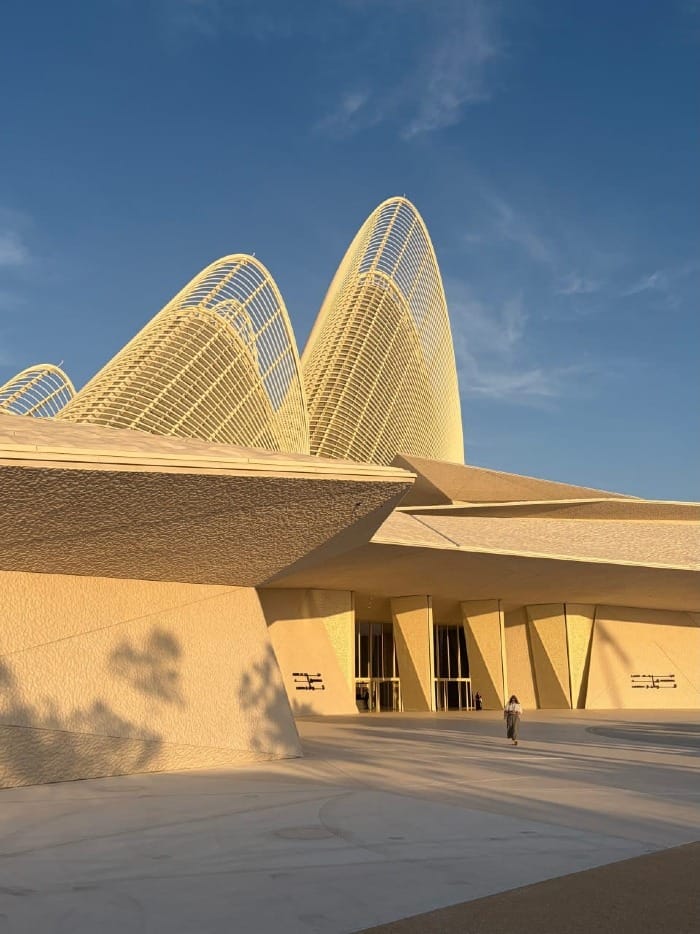
I want to write separately about the brand-new Sheikh Zayed National Museum. It is one of the most expensive constructions I have ever seen in my life. $680 million, 18 years of building, opened only in December 2025, and when I visited in January it still smelled of paint. Lots of air. The building is a complex architectural form: five steel falcon-wing towers (the tallest at 123 meters) are not just aesthetics but literally a ventilation system. The towers work as thermal chimneys drawing hot air upward, while underground pipes carry cooled air in from below — the principle of the barjeel, the region's traditional wind towers, reimagined by Norman Foster. The concrete was chosen to match the white sand of Saadiyat island, shadows and natural light arranged so that you feel like you're inside a dune.
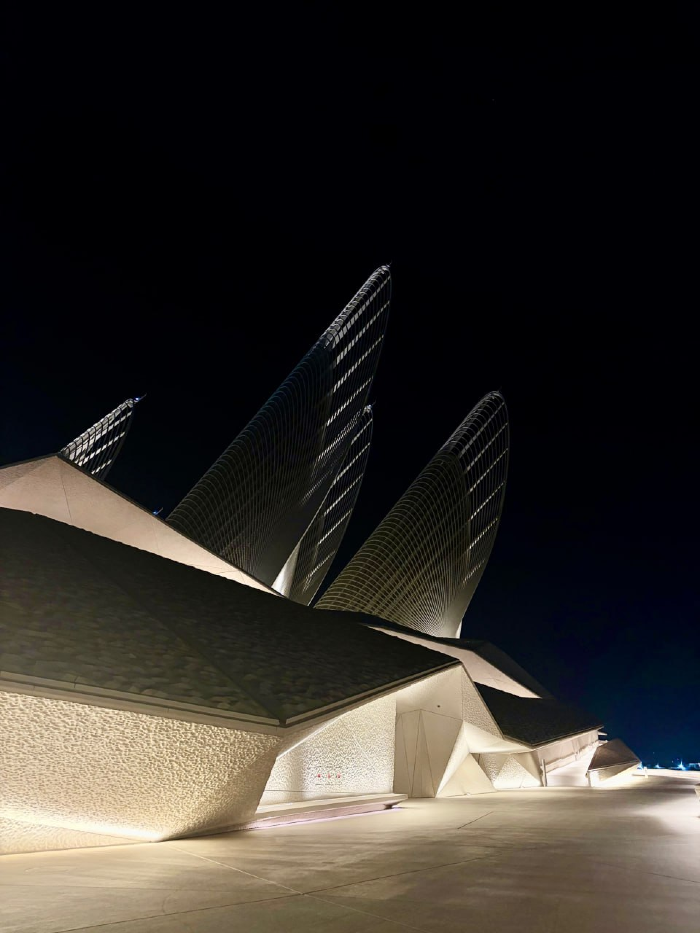
The galleries sit in suspended capsules above the atrium, light slits between them, each capsule in triple laminated glass with an internal mesh to regulate light for sensitive exhibits. In the shop, expensive merch with the Sheikh's face. In the exhibition, you can smell a camel, release a falcon, and cook a traditional dish on a digital screen.
The halls tell the story of how exactly such a prosperous state got built in such a short time. Over 3,000 objects, 1,500 in the permanent collection. Starting with "Our Beginning" — the Sheikh's personal belongings, his voice in recordings, archival footage. Then nature: mountains, oases, desert, sea. Then 300,000 years of continuous human presence on this land and one of the oldest pearls in the world, a reconstruction of the Hili tomb. Trade across the Persian Gulf, the spread of Islam, coastal settlements, pearl diving as a catalyst for cultural exchange. And the enormous Al Masar garden: 600 meters, 900 plant species, an irrigation system based on ancient falaj canals, a viewing platform overlooking Saadiyat.
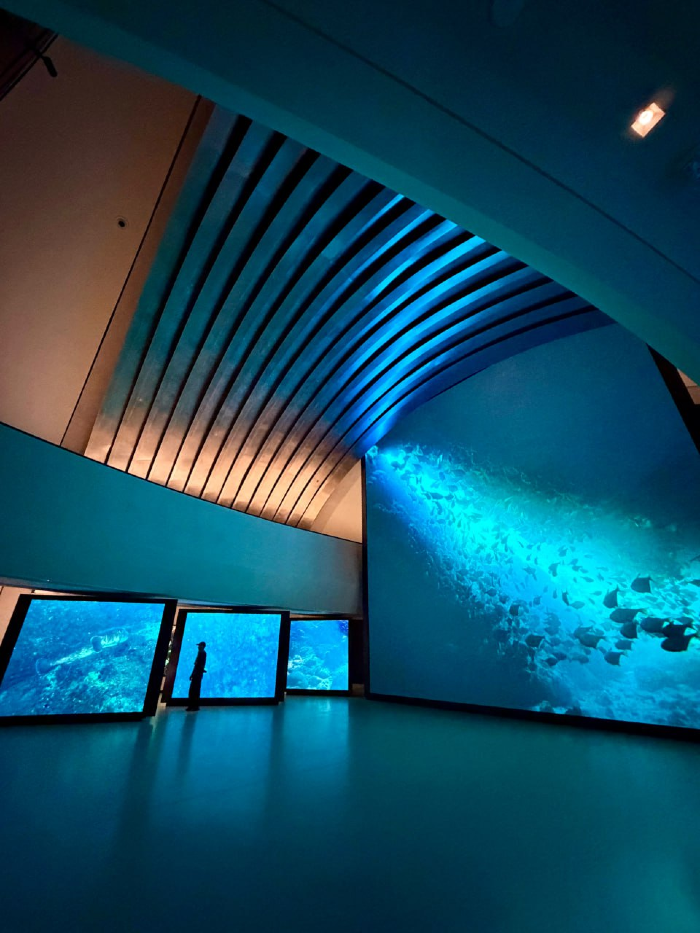
Monumental, very beautiful and propagandistic.
The takeaway after visiting is roughly the same as any national museum in any country, but here it costs upwards of $680 million and is built from concrete mixed with marble.